What To Eat In Taipei During Winter: A Local’s Guide to the Best Warming Foods

This post is about the seasonal foods you can find in Taipei during winter and what locals love to eat when the weather gets cold. If you are visiting Taipei and want to try some winter specialties, this post is for you.
The climate in Taiwan is often described as tropical, but winter in northern Taiwan feels very different. Taipei sits in a basin surrounded by mountains, which traps moisture and limits air movement. Because of the high humidity, winter days in Taipei often feel noticeably colder than what the temperature suggests, especially on cloudy/rainy days.
To deal with the “bone-chilling” cold, there’s a strong local tradition of eating specific foods to ‘dispel the cold’ (祛寒), nourishing the body and staying warm.
These days, I have returned to Taipei only in the summer because of my school-age child. But during my younger years, when I was working in Mainland China, I went back to Taipei more often, including during winter.
Many of my strongest food memories come from those winter visits. Cold evenings were spent eating hot pot with friends and family, enjoying herbal soups, and picking up warm snacks from street stalls and convenience stores.
Below, I’ll introduce the foods you can easily find in Taipei when you visit during winter.
1. Ginger Duck Hot Pot (薑母鴨)
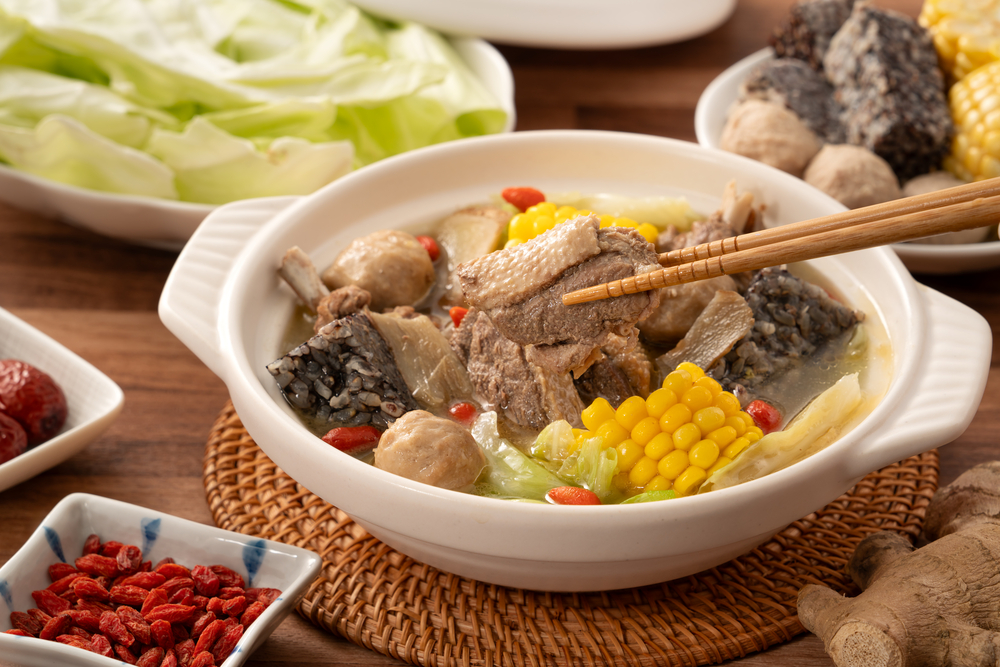
This is one of the most iconic winter foods in Taiwan.
Ginger duck has a very distinct flavor. The old ginger and sesame oil give the broth a strong, fragrant base, and the rice wine adds warmth. It’s the kind of dish that feels right on a cold night.
This dish is served in a hot pot style, meant to be eaten as a group meal. The pot is kept simmering at the table, and additional ingredients like cabbage, mushrooms, tofu, and noodles are often added as you eat. It’s about sitting, talking, and staying warm.
I actually had my first ginger duck experience when I was working/living in Mainland China. In Suzhou, there was a popular Taiwanese restaurant dedicated entirely to ginger duck, and it quickly became a go-to place during winter.
Many winter evenings were spent there with friends, sharing a pot and lingering over the meal. Those are some of my fondest food memories from that period.
I once went to this restaurant (Google Maps:霸味薑母鴨(三重), ) in Taipei with a group of friends on a chilly winter evening. The tables and seats were set low, which gave the space a very distinctive and casual feel. It was a place where people lingered, talked, and shared a hearty meal, and the atmosphere made the experience especially memorable for me.
These days, I’m only able to spend extended time in Taiwan during the summer because of my school-age son. Ginger duck hot pot is one of the things I miss most about winter in Taiwan.
I also asked around my friends for additional recommendations. Here are a couple of other popular ginger duck restaurants located in Taipei, and their Google Maps links:
What’s interesting about ginger duck restaurants is that they typically only operate for about 6 months each year and close during the hotter months.
Many of these places rent out their storefronts to businesses that sell shaved ice in summer, so they have less pressure for rent and utility bills. In addition, most restaurants run as family businesses, so staffing is less of an issue.
The fact that they can earn enough during the colder months and then take a long break says a lot about how popular Ginger Duck is in winter!
By the way, if you are feeling overwhelmed by all the choices in Taipei, I can help. You can send me your itinerary for a review, and I’ll give you my feedback to make sure your trip is smooth and enjoyable. Just Click Here to learn more.
2. Mutton Hot Pot (羊肉爐)
Just like ginger duck, mutton hot pot is also meant to be shared.
You’ll often hear people mention 冬令進補: the idea that winter is a time to nourish the body. Mutton is considered warming, which is why this dish shows up so often during the colder season.
Some people worry about the gamey taste of mutton, and that hesitation is common. When it’s done well, though, the meat is tender and the flavor is balanced, without the strong gamey taste many people expect.
The broth is usually simmered with mutton and herbs. Some versions are light and clear, while others are richer and more concentrated. Compared to ginger duck, mutton hot pot tends to taste milder and less intense.
Like the Ginger Duck restaurants, Mutton hot pot restaurants also operate in the colder months of the year. The popular ones in Taipei are:
3. Hot Pot (火鍋)

Besides ginger duck and mutton hot pots, there are many other hot pot restaurants dedicated to different types of broths and styles.
Some places focus on spicy broth (Sichuan hot pot, 麻辣鍋), while others offer clear or herbal soups, and many have both. In recent years, personal hot pot restaurants have also become popular, making it easy to find a place that works for both large groups and solo diners.
They operate year-round, unlike ginger duck and mutton hot pot places that usually only operate during the colder months.
I know what you might be thinking: Do they get enough business during the hotter months?
Well, I used to think eating hot pot in warm weather sounded strange, until I found myself sitting in a crowded, fully air-conditioned restaurant and enjoying it anyway. At that point, it became pretty clear to me that Taiwanese people just love hot pot, no matter the season!
The place that I usually go with my friend Carrie is a chain for personal hot pot: 錢都刷刷鍋。 You can click on the link to find a location that’s convenient for you. This chain is considered very budget-friendly.
4. Sesame Oil Chicken (麻油雞)
Sesame oil chicken is made with chicken, sesame oil, ginger, and rice wine. It is a soup dish rather than a cook-at-the-table hot pot. People like to add wheat noodles (麵線) to the soup and eat it that way.
Compared to ginger duck or mutton hot pot, sesame oil chicken feels more home-style and familiar. It’s something many people grew up eating, even though it wasn’t common in my own family.
This dish is also commonly eaten during 坐月子, the traditional postpartum recovery period. Because of that, people associate sesame oil chicken with warmth and nourishment, which also ties it naturally to the idea of 冬令進補 and winter eating.
While I have not tried any Sesame oil chicken restaurant in Taipei, my friend Vivian highly recommends this chain: 阿圖麻油雞.
5. Sishen (Four Herbs) Soup (四神湯)
This is a light soup that is made with four types of herbs: lotus seeds, Chinese yams, poria, and gorgon fruit. In Taiwan, you’ll also see job’s tear (薏仁), pork ribs, or pork intestines added to the soup.
It’s the kind of soup you drink when you want something warm without feeling overly full.
This is the place that we like: 阿桐阿寶四神湯, it’s pretty close to Ningxia Night Market (寧夏夜市).
6. Tangyuan (湯圓)

Tangyuan are glutinous rice balls served in a warm sweet soup, and they’re closely tied to winter in Taiwan.
For many Taiwanese people, eating tangyuan on the day of 冬至 (Dongzhi, the Winter Solstice and the shortest day of the year) is an important tradition, and it’s one my family follows as well.
Even though I now live abroad, I still go to an Asian supermarket to buy a pack of tangyuan when winter comes. I usually choose the ones filled with black sesame or red bean paste, and my son enjoys them too.
As for where to eat tangyuan, if you’re already planning a meal at Din Tai Fung, it’s worth ordering their tangyuan for dessert. It’s not their main focus, but I tried it a while ago and remember it being very good.
If you have access to a kitchen during your stay, you can pick up a pack of tangyuan from the frozen section of a supermarket or even a convenience store. Simply put them in boiling water for about 8-10 minutes, and they’re ready to eat.

7. Hot Grass Jelly (燒仙草)
Grass jelly is usually associated with summer, but in winter, it shows up in a completely different form.
Hot grass jelly has a thicker, more syrup-like texture and a mild, slightly herbal flavor. It’s not overly sweet, which makes it easy to enjoy even after a heavy meal.
Hot grass jelly is rarely served on its own. Most shops add toppings like red beans, peanuts, taro balls, or sweet potato balls. You’ll often see stalls selling it at night markets, and some dessert chains, like Meet Fresh, also offer hot grass jelly alongside their taro-based desserts.
8. Red Bean Cakes (紅豆餅)

Red bean cakes are a common street. snack. You’ll often see small stalls making them fresh to order. Though you can find them year-round, the hot red bean paste filling is especially suitable in the cooler months.
The batter is poured into round molds, filled with red bean paste, and cooked until the outside is lightly crisp while the inside stays soft. Red bean is the classic filling, but many stalls also offer custard, taro, or peanut.
Red bean cakes are one of my favorite snacks. Every time I go back to Taiwan, they’re always on my must-eat list, along with tofu jelly (豆花). The photo above is a red bean cake my dear friend Chynna brought me when we met up in Taipei last summer. It was so sweet of her to remember my favorite snack!
9. Sweet Potatoes (地瓜)

The most common place to get them is at convenience stores. Many 7-Eleven and FamilyMart locations keep steamed sweet potatoes warm near the entrance, making them an easy snack to grab while walking around.
You’ll also see street carts selling them along busy roads, and they’re often available at night markets during the colder months.
They’re usually eaten plain, with no seasoning added. The outside is soft and warm, and the natural sweetness of the potato stands out more in winter. It’s inexpensive, filling, and very easy to find, which is why so many people reach for it on a cold day.
Final Thoughts
Winter in Taipei may feel colder than expected, but the food makes the season much easier to enjoy. From hot pots and herbal soups to warm desserts and street snacks, these are the foods locals naturally turn to when the weather gets cold.
If you’re visiting Taipei in winter, you don’t need to go out of your way to find these dishes. Many of them are easy to spot, widely available, and fit naturally into everyday life here. Trying a few of them is a simple way to experience Taipei during the colder months.
If you are feeling overwhelmed by all the choices in Taipei, I can help. You can send me your itinerary for a review, and I’ll give you my local’s feedback to make sure your trip is smooth and enjoyable. Just Click Here to learn more.