My First Ever Binge-Watched TV Show: Budaixi
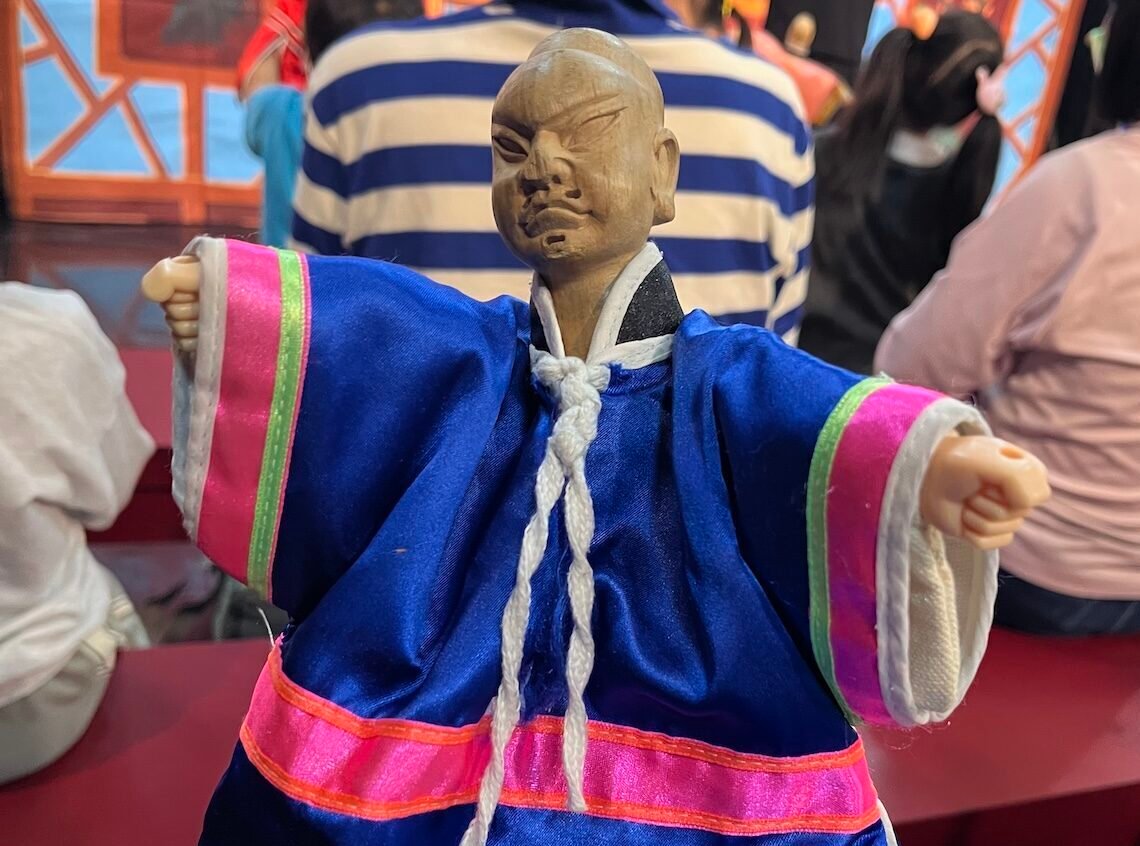
When I was 7 or 8, school let out at noon. Every day, I’d rush home, sit in front of the TV with my lunch, usually in a bowl balanced in my lap, and watch an episode of Budaixi (布袋戲), Taiwanese puppet theater.
It was basically a long-running drama series, except the actors were hand puppets instead of people.
The story took place in a fictional jianghu 江湖, an old martial-arts world where heroes and villains crossed paths and fought. I don’t remember any specific plots anymore, and I can recall only a few of the characters.
But I do remember the music.
Each main character had a theme song. Whenever a certain character appeared, you would hear that familiar song first, almost like an announcement that they had arrived.
My favorite was a female character whose name I’ve long forgotten. She wore a beautiful pink costume, and her weapon was a long pink sash. Her theme song was literally called “Pink Sash.” I remember singing along whenever she appeared. Decades later, I can still hum pieces of the melody and even remember a few lines of the lyrics.
Performers behind the stage controlled the movements by hand. The puppets’ mouths could open and close, their arms could move, but their facial expressions were always the same, so were their costumes.
And yet, somehow, they felt completely alive to me.
They had dramatic entrances, larger-than-life personalities, and epic battles between good and evil. Besides the interesting storyline, I think much of the magic came from the sound effects, the background music, the voices, and the way the fight scenes were choreographed.
Two experiences this past summer brought those memories back.
One was visiting the Taipei Puppet Museum with my son. We watched a puppet show intended for children, and the moment the percussion instruments started playing, something felt instantly familiar. That rhythm, especially the sharp clashing of the instruments, seemed to come from somewhere deep in my memory. I must have heard it countless times as a child, perhaps at temple performances, perhaps on television.
The other moment came at the National Taiwan Museum.
As I stood looking at the puppets on display, I found myself studying their elaborate costumes and hairstyles. The details were much more intricate than I remembered. Seeing them again made me curious about what had happened to the kind of Budaixi I watched as a child.
Later, I started looking into the work of Huang Chun-Hsiung (黃俊雄), whose puppet shows had been such a familiar part of Taiwanese television. His sons eventually took the family craft in their own direction, developing what became Pili Budaixi (霹靂布袋戲), one of the best-known names in Taiwanese puppetry today.
The characters have changed since my childhood, but Budaixi itself never stopped evolving.
The way people watch it has changed too. Instead of gathering around the television at a certain time of day, audiences can now watch through DVDs, streaming platforms, and YouTube. Pili has even expanded beyond Taiwan, including collaborations with Japanese creators and productions that have appeared on Netflix.
It has been decades since those afternoons in front of the television, and most of the details are gone. I don’t remember the storylines. I don’t remember why the woman with the pink sash was fighting, or even who she was fighting.
But I remember the feeling.
I remember rushing home from school, settling in front of the TV with my lunch, and becoming completely absorbed in whatever happened next.
Looking back, I realize I was already binge-watching a drama before I even knew what binge-watching was.
I was seven or eight years old.